
Poland has a well-developed forestry sector and a corresponding network of lumber suppliers ranging from large building material chains to small regional sawmills. For interior woodcraft projects — shelving, joinery, furniture construction, and restoration — the species available vary by region and season, but a consistent core of options is reliably accessible across the country.
Understanding What the Project Requires
Selecting timber is not a matter of personal preference alone. The intended use determines acceptable moisture content, grain structure, and surface quality. A tabletop that will carry daily use and be finished with an oil demands different characteristics than a decorative wall panel or a structural shelf bracket.
The first practical step is obtaining kiln-dried (KD) stock rather than air-dried or green lumber for any interior application. In Poland, this is sometimes labelled as suszone komorowo at sawmills, and the moisture content should be around 8–12% for indoor furniture. Timber at higher moisture content will shrink and potentially warp as it adjusts to heated interior conditions.
Wood movement is determined by its species, cut, and moisture differential — not just thickness. Quarter-sawn boards are significantly more stable across their width than flat-sawn boards cut from the same log.
Oak (Dąb)
European oak (Quercus robur and Quercus petraea) grows throughout Poland and is the most commonly used native hardwood in furniture. It is sold in most large timber yards and through specialist sawmills in regions like Mazowsze and Małopolska.
Properties and Uses
Oak is hard, open-grained, and contains tannins — organic compounds that react with iron, turning the wood black on contact with steel fixings or certain finishes. Using stainless or brass hardware avoids this reaction. Its Janka hardness makes it suitable for tabletops and flooring, and its grain accepts stains predictably, though the open pores require filling if a smooth lacquered surface is desired.
Quarter-sawn oak displays medullary rays — fine silver streaks running across the face — which are considered a mark of quality in traditional furniture. Boards showing this characteristic often cost more but move less in service.
Pine (Sosna)
Scots pine (Pinus sylvestris) is the dominant softwood in Poland and is the most widely available and affordable timber species. It is found in virtually every building supply store and many sawmills across the country.
Properties and Uses
Pine is much softer than oak and dents easily under impact. For table surfaces in high-use situations, this is a drawback. However, for shelving, painted furniture, and pieces where a rustic or distressed appearance is acceptable, pine is a reasonable choice. It takes paint well but absorbs stain unevenly due to resin pockets and variable grain density. Conditioning the wood with a pre-stain conditioner before any pigmented finish helps achieve more uniform colour.
Ash (Jesion)
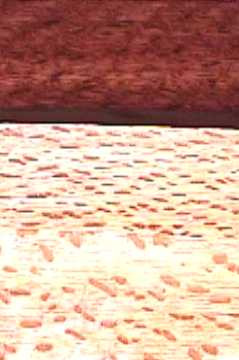
European ash (Fraxinus excelsior) is a pale, straight-grained hardwood with a prominent open grain similar to oak but slightly lighter in weight. It has traditionally been used for tool handles and sports equipment due to its flexibility and shock resistance, and it is a practical choice for furniture that needs to be both strong and relatively light.
In Polish lumber yards, ash is less common than oak but not difficult to source. It bends well with steam, making it suitable for chair components. Its natural colour — a creamy white to pale brown — responds well to oil finishes without staining, and it can be lightly tinted to match oak tones in mixed-wood projects.
Sourcing Considerations in Poland
For small quantities, Leroy Merlin and Castorama carry standard dimensional pine and some oak in their timber sections. For better-quality hardwood in larger quantities, regional sawmills (tartaki) are a more appropriate source. The website Drewno.pl provides a directory of Polish timber producers and suppliers.
When purchasing from a sawmill, request boards that have been sorted for grain and moisture content, and ask for documentation of the drying process if using the timber for interior furniture. Surface-planed boards cost more but save considerable time in preparation.